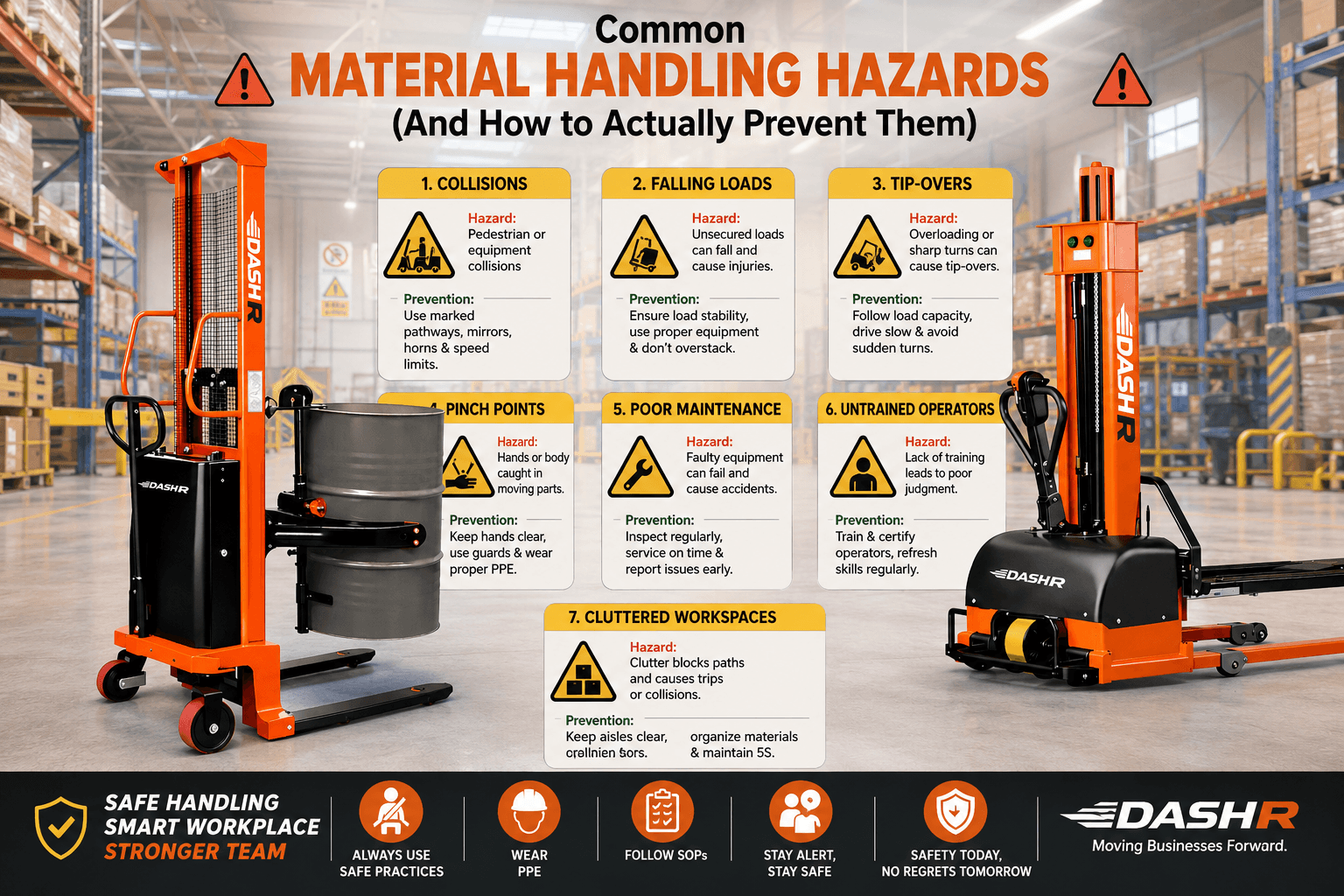
Walk through any warehouse or manufacturing floor for a day, and you'll notice something: most accidents don't happen because of some freak, unpredictable event. They happen because of the same handful of hazards, repeating themselves quietly until something finally goes wrong.
The good news is that almost all of these are preventable — with the right training, the right processes, and honestly, a lot of it comes down to using the right material handling equipment in the first place. Here's a practical rundown of the hazards we see most often, and what actually helps.
Forklifts are probably the single biggest source of material handling injuries, and it's not usually because the equipment fails — it's because of how it's used.
Common causes:
What helps: Regular pre-shift inspections, proper operator certification, and — this one gets overlooked a lot — actually matching the forklift to the job. A forklift that's undersized for your loads or too large for your aisles isn't just inefficient, it's a hazard by design. If you're not sure your current equipment fits your operation, it's worth a second look.
Loads that aren't properly secured, stacked, or balanced are a major hazard — both to workers below and to whoever's transporting them.
Common causes:
What helps: Using pallets rated for the load they're carrying, training staff on proper stacking height and technique, and inspecting pallets regularly for cracks or weak points. It sounds basic, but a huge share of "falling load" incidents trace back to a pallet that should've been retired months earlier.
Racking systems that are poorly designed, overloaded, or damaged are a hazard that tends to build up slowly — a slightly bent frame here, an overloaded shelf there — until a collapse happens.
Common causes:
What helps: Routine visual inspections of your racking systems, clear load capacity signage on every level, and a strict "report any collision, however minor" policy. Damaged racking should be taken out of use immediately, not "monitored" for a few weeks first.
Not every material handling hazard involves machinery — a lot of it is just people lifting, carrying, and moving things by hand, day after day.
Common causes:
What helps: This is exactly where equipment like pallet trucks, stackers, and scissor lift tables earns its keep — reducing how much manual lifting your team actually has to do. Fewer manual lifts means fewer strains, fewer sprains, and a lot less absenteeism from back injuries.
An overlooked hazard: equipment that's simply been running too long without proper servicing. Hydraulic leaks, worn brakes, weakened chains — none of these fail suddenly. They fail gradually, and usually give warning signs that get ignored.
Common causes:
What helps: A maintenance schedule that's actually followed, not just written down — plus a simple culture where operators feel comfortable flagging small issues before they become big ones.
Simple, but genuinely one of the most common hazards in busy warehouses. Boxes left in aisles, cables running across walkways, poor lighting in corners — these cause more slips, trips, and near-misses than people expect.
What helps: Clear floor markings separating pedestrian paths from equipment routes, good lighting throughout the facility, and a basic "clear as you go" habit built into daily operations.
Notice a pattern here? Almost every one of these hazards ties back to either untrained handling, poor maintenance, or mismatched equipment — using the wrong forklift, an overloaded pallet, or a racking system that was never designed for the load it's carrying.
That last one is where we can actually help. A lot of material handling hazards quietly disappear the moment you're working with equipment that's properly suited to your load, your space, and your pace of operations — rather than whatever happened to be available or affordable at the time.
If you're not fully confident your current setup is safe for how your operation actually runs, it's worth a proper look. Explore our full range of forklifts, pallet trucks, racking systems, and other material handling equipment built for exactly this kind of everyday reliability — or get in touch with our team for a straightforward assessment of what your operation actually needs.
What's the most common cause of material handling accidents? Forklift-related incidents tend to top the list, but a large share of accidents across all categories come down to the same root causes — inadequate training, skipped maintenance, or equipment that doesn't match the load or environment it's being used in.
How often should material handling equipment be inspected? Daily pre-shift checks are essential for active equipment like forklifts and pallet trucks, with more thorough servicing every 200–500 operating hours depending on usage and manufacturer guidelines. Racking systems should get a visual inspection on a regular schedule too, not just after a visible incident.
Can better equipment actually reduce workplace injuries? Yes — a significant share of manual handling injuries drop simply by introducing the right mechanical aids, like pallet trucks or scissor lift tables, for tasks that were previously done by hand.
